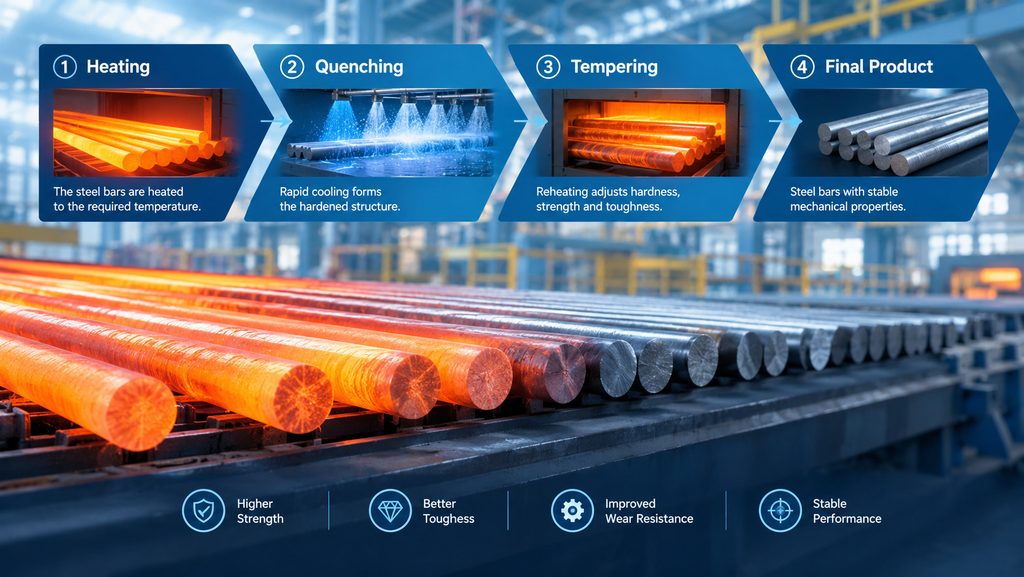
The quenching and tempering process is a heat treatment method used to adjust the strength, hardness, and toughness of steel. It combines controlled heating, rapid cooling during quenching, and a subsequent tempering stage to obtain mechanical properties suited to the intended application.
For steel bar manufacturers, a continuous quenching and tempering line can integrate these stages with automated material conveying and temperature control. The results depend on the steel grade, bar diameter, heating conditions, cooling method, and tempering parameters.
This guide explains how the quenching and tempering process works, which equipment is involved, and what manufacturers should consider when selecting a continuous steel bar heat treatment line.
What Is the Quenching and Tempering Process?
Quenching and tempering is a heat treatment process in which steel is first heated under controlled conditions and then cooled rapidly to develop the required hardened structure. It is subsequently reheated below the lower critical transformation temperature and cooled again to adjust the final mechanical properties.
Quenching establishes the hardened structure. Depending on the steel composition and cooling conditions, this may involve the formation of martensite and other transformation products.
Tempering adjusts the structure formed during quenching. It commonly reduces quenching stresses and brittleness while improving toughness and dimensional stability. The final balance between strength, hardness, and toughness depends on the material and the selected heat treatment parameters.
The required temperature and holding time are not the same for every steel grade. They must be selected according to the material composition, bar dimensions, initial microstructure, and target mechanical properties. ISO 4885:2026 provides terminology for these heat treatment operations, while ASM’s heat treatment references discuss the factors affecting tempering response.
Main Stages of the Quenching and Tempering Process
1. Heating the Steel Bars
The steel bars are heated to the temperature required for the specified heat treatment. For conventional hardening, the steel is generally heated into an austenitizing range before quenching. The exact temperature depends on the grade and whether full or partial austenitization is required.
In a continuous line, heating uniformity is important because temperature differences along or across the bar can contribute to variations in transformation and final properties.
The heating system should therefore be selected according to the steel grade, bar diameter, production rate, and process requirements.
2. Quenching and Controlled Cooling
After heating, the bars are cooled using the specified quenching method. The cooling rate affects the transformation of the steel microstructure and consequently influences hardness, strength, residual stress, and the risk of distortion or cracking.
Cooling requirements vary with steel composition, cross-sectional dimensions, hardenability, and the desired mechanical properties. Excessively severe or uneven cooling can increase the risk of defects, while insufficient cooling may prevent the required structure from forming.
For this reason, the cooling method and its operating parameters must be matched to the steel and bar dimensions rather than selected using a universal setting.
3. Tempering
Following quenching, the bars are reheated under controlled conditions to achieve the required combination of mechanical properties.
Tempering temperature and holding time affect the final hardness, strength, toughness, and dimensional stability. The correct settings depend on the steel grade and required product specification.
A lower or higher tempering temperature can produce different property combinations. There is no single tempering temperature that suits all steel bars, so the process should be developed from the material specification and verified through testing.
4. Final Cooling and Quality Inspection
After tempering, the bars are cooled according to the selected process. The finished material is then checked against the required product specifications.
Depending on the application, inspection may include hardness testing, tensile testing, impact testing, dimensional checks, and other relevant examinations. The required tests and acceptance limits should be defined by the applicable material standard or customer specification.
Production settings should be reviewed against actual test results before the process is treated as stable.
Equipment Used in Continuous Steel Bar Quenching and Tempering
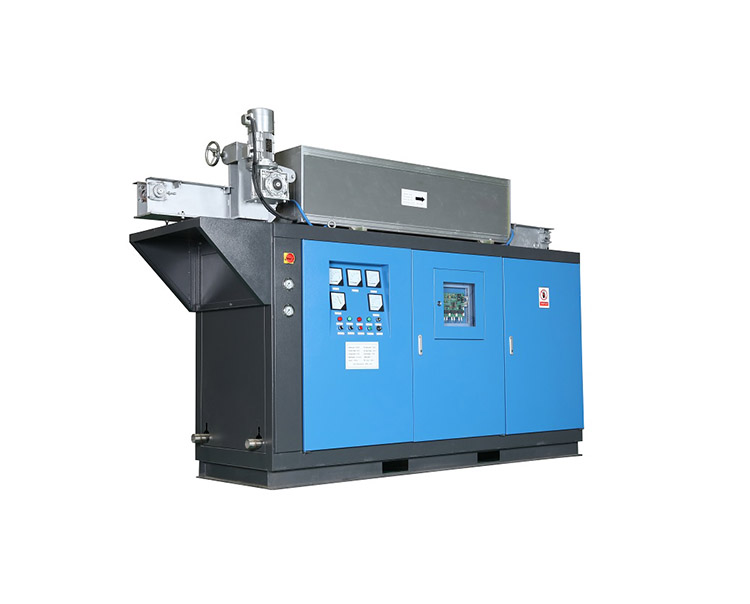
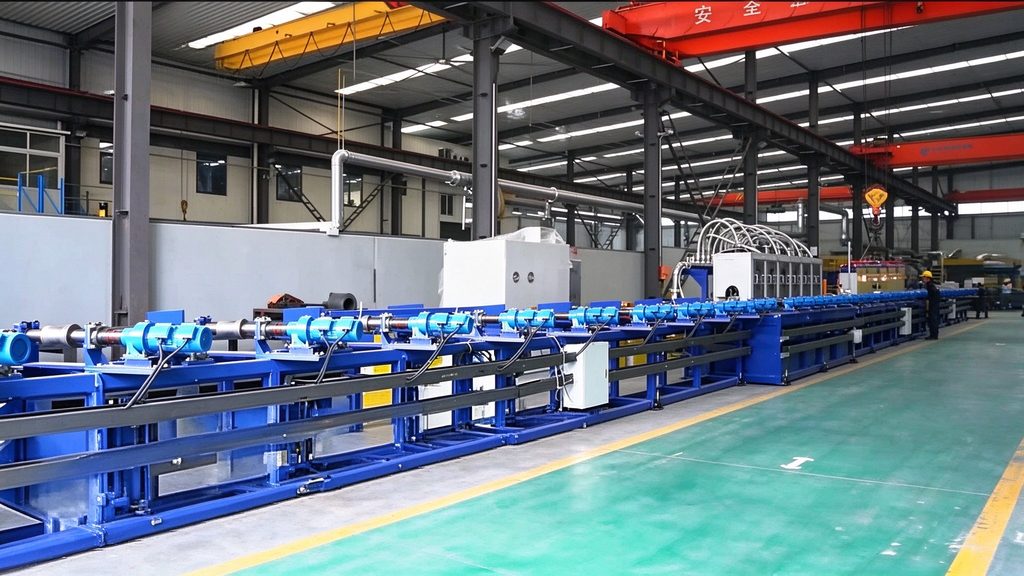
A continuous quenching and tempering line integrates heating, conveying, cooling, reheating, and control equipment into a coordinated production process. The exact arrangement depends on the line design and the steel products being processed.
| Equipment or system | Main function | Important considerations |
|---|---|---|
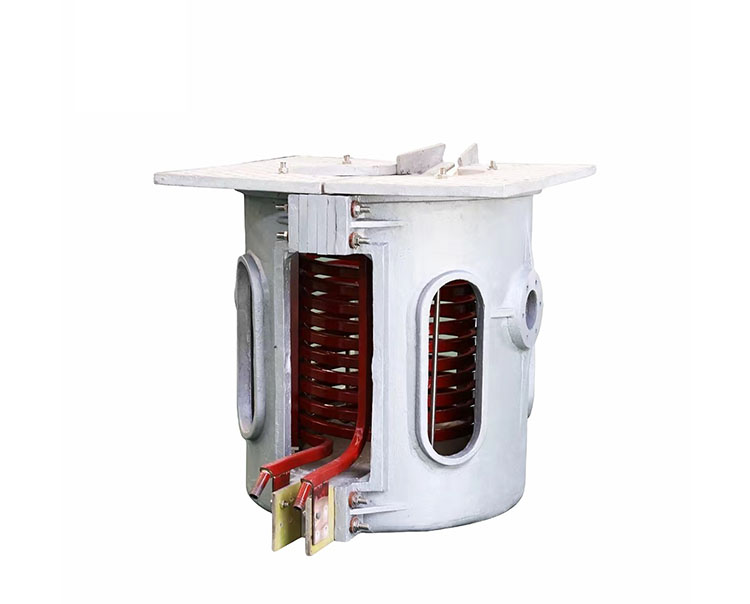
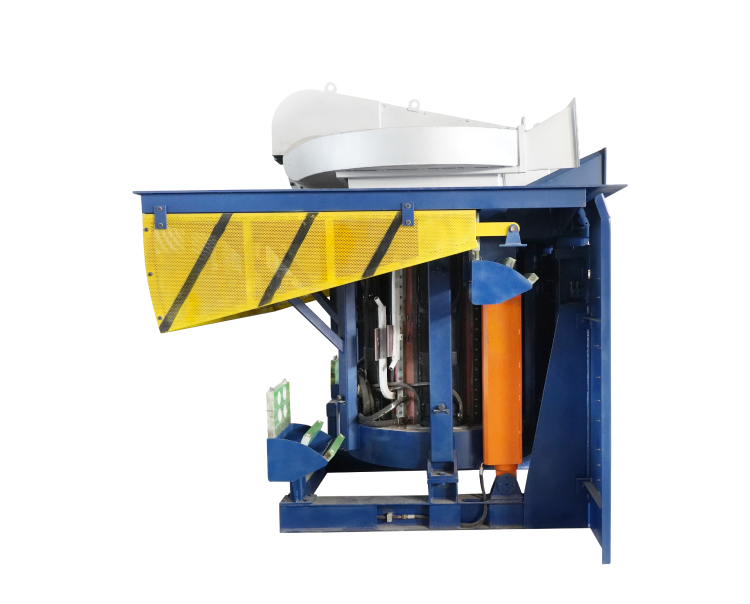
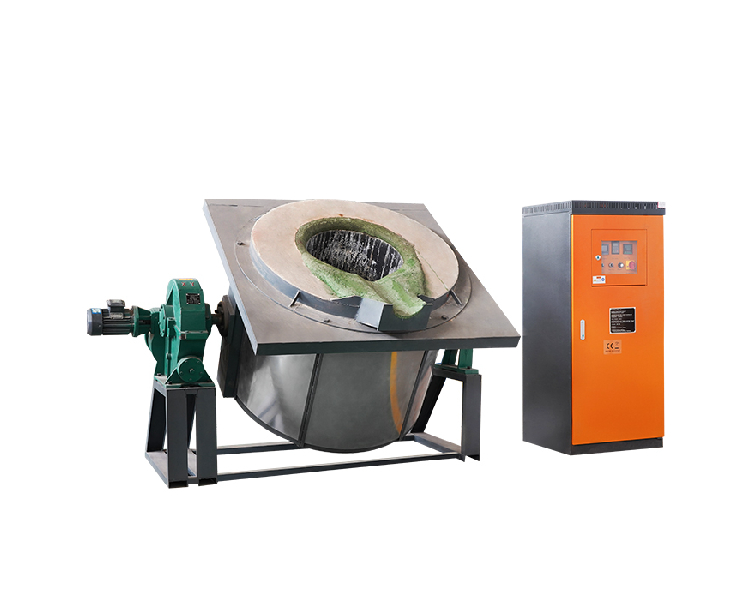
| Induction heating system | Heats the bars under controlled conditions | Temperature uniformity, bar diameter, steel grade, and line speed |
| V-shaped inclined roller conveyor | Moves and rotates bars through the line | Conveying stability, alignment, and compatibility with bar dimensions |
| Quenching and graded cooling system | Cools heated bars according to the process requirements | Cooling uniformity, adjustable parameters, and material response |
| Tempering heating system | Reheats quenched bars to develop the required final properties | Temperature control and the specified tempering cycle |
| PLC and control system | Coordinates operating parameters and production sequences | Parameter adjustment, monitoring, and traceability |
| Inspection equipment | Verifies final quality | Required hardness, mechanical properties, dimensions, and sampling plan |
Our steel bar continuous quenching and tempering line is designed for continuous, automated heat treatment of steel bars, including round steel and alloy bars.
The product page lists a V-shaped inclined roller drive that rotates bars during conveying, intelligent induction temperature control, adjustable graded cooling, and PLC operation with adjustable parameters and data traceability.
These features are intended to support more consistent heating and cooling across the production process. Actual performance should be confirmed against the specified steel grade, bar dimensions, process conditions, and acceptance criteria.
Continuous Quenching and Tempering Line Specifications
The published product information lists the following operating scope:
| Parameter | Value listed on the product page |
|---|---|
| Applicable bar diameter | Φ10–150 mm |
| Production capacity | 0.5–3.5 t/h |
| Material examples | Round steel bars and alloy bars |
| Conveying arrangement | V-shaped inclined roller drive |
| Temperature control | Intelligent induction temperature control |
| Cooling arrangement | Adjustable graded cooling |
| Control system | PLC operation with adjustable parameters and data traceability |
These values describe the range listed on the product page. They should not be interpreted to mean that every bar diameter or steel grade can be processed at the maximum stated throughput. Actual output depends on the material, required properties, process cycle, and selected configuration.
Before purchasing, confirm the expected production rate for the specific bar diameter, steel grade, and heat treatment specification.
Factors That Affect Quenching and Tempering Results
Steel Grade and Composition
Carbon content and alloying elements affect hardenability and response to heat treatment. A process suitable for one steel grade may not produce the same hardness or strength in another.
The material specification should therefore be confirmed before the heating and cooling parameters are established.
Bar Diameter and Cross-Section
Bar dimensions influence heating behavior and the rate at which heat is removed during quenching. Larger sections may develop different temperature gradients from smaller sections, which can affect the resulting microstructure and mechanical properties.
The line must be configured for the actual diameter range and production requirements.
Heating Uniformity
Uneven heating can lead to variations in transformation and properties. In continuous production, conveying alignment, bar rotation where applicable, heating control, and line speed all influence thermal consistency.
Quenching Conditions
Cooling medium, flow arrangement, temperature, and cooling intensity affect transformation behavior. The correct conditions depend on the material and the desired properties, and should be established using qualified process parameters.
Tempering Parameters
Tempering temperature and time affect the final balance of strength, hardness, and toughness. Incorrect settings may result in properties that fall outside the required specification.
Process validation should therefore include appropriate hardness and mechanical testing rather than relying solely on equipment temperature readings.
Quenching and Tempering vs. Induction Hardening
Quenching and tempering and induction hardening are related heat treatment processes, but they do not necessarily serve the same purpose.
| Comparison factor | Quenching and tempering | Induction hardening |
|---|---|---|
| Main objective | Develop a specified balance of strength, hardness, and toughness | Increase surface hardness and wear resistance |
| Heating approach | Depends on the selected process and equipment; continuous induction heating can be used | Induction heating is concentrated in the surface region intended for hardening |
| Treatment result | Depends on the steel, section size, and process route; may target properties through the section | Typically produces a hardened surface layer with a comparatively less-heated core |
| Typical equipment focus | Heating, quenching, tempering, conveying, and process control | Induction heating, scanning or rotation where required, and quenching |
| Key selection inputs | Steel grade, bar diameter, target mechanical properties, and throughput | Steel hardenability, required hardened depth, surface hardness, and component geometry |
Our existing induction hardening guide discusses steel selection and surface-hardening considerations. It complements this article but addresses a different treatment objective.
The appropriate method depends on the required component properties and material specification. One process should not be substituted for the other without confirming the intended hardness distribution and mechanical performance.
How to Select a Steel Bar Quenching and Tempering Line
Before requesting a quotation, manufacturers should define the process and production requirements.
1. Confirm the steel grades. Provide the material grades and their chemical specifications. Different compositions can require different heating and cooling conditions.
2. Define the bar diameter range. State the minimum and maximum diameters and identify the sizes that will account for most of the production volume.
3. Specify the required properties. Define the target hardness, strength, toughness, and any other acceptance criteria. These requirements determine the heat treatment route and the testing plan.
4. Establish production targets. Confirm the expected throughput, operating hours, and product mix. The supplier should clarify achievable output for the actual material and heat treatment cycle.
5. Review automation and process control. Confirm the available temperature controls, adjustable cooling parameters, PLC functions, and production data records. These features can support repeatability but do not replace process validation.
6. Confirm the scope of supply. Identify which heating, quenching, tempering, conveying, cooling, inspection, installation, and commissioning items are included in the proposed line.
7. Agree on quality verification. Establish the test methods and acceptance criteria for the finished bars before commissioning. The process should be verified against these requirements rather than judged only by nominal production capacity.
Conclusion
The quenching and tempering process combines controlled heating, rapid cooling, and subsequent tempering to produce steel with the required mechanical properties. Its results depend on the steel grade, bar dimensions, heating uniformity, cooling conditions, and tempering parameters.
A continuous steel bar heat treatment line coordinates these operations with material conveying and process control. Selecting the right equipment requires matching the production range and target properties to the actual line configuration and validating the process through appropriate material testing.
For continuous bar heat treatment, see our steel bar continuous quenching and tempering line. To discuss a project-specific configuration, contact our technical team with your steel grades, bar diameters, target mechanical properties, and production requirements.