How Should Materials Be Batched for Aluminum Alloy Production?
Aluminum alloys contain many different alloying elements. Even when the same elements are used, their contents may vary. Therefore, selecting the proper raw materials for aluminum alloy batching is very important. It helps control the chemical composition of the finished alloy, ensures ingot quality, saves raw materials, and improves the economic efficiency of the enterprise.
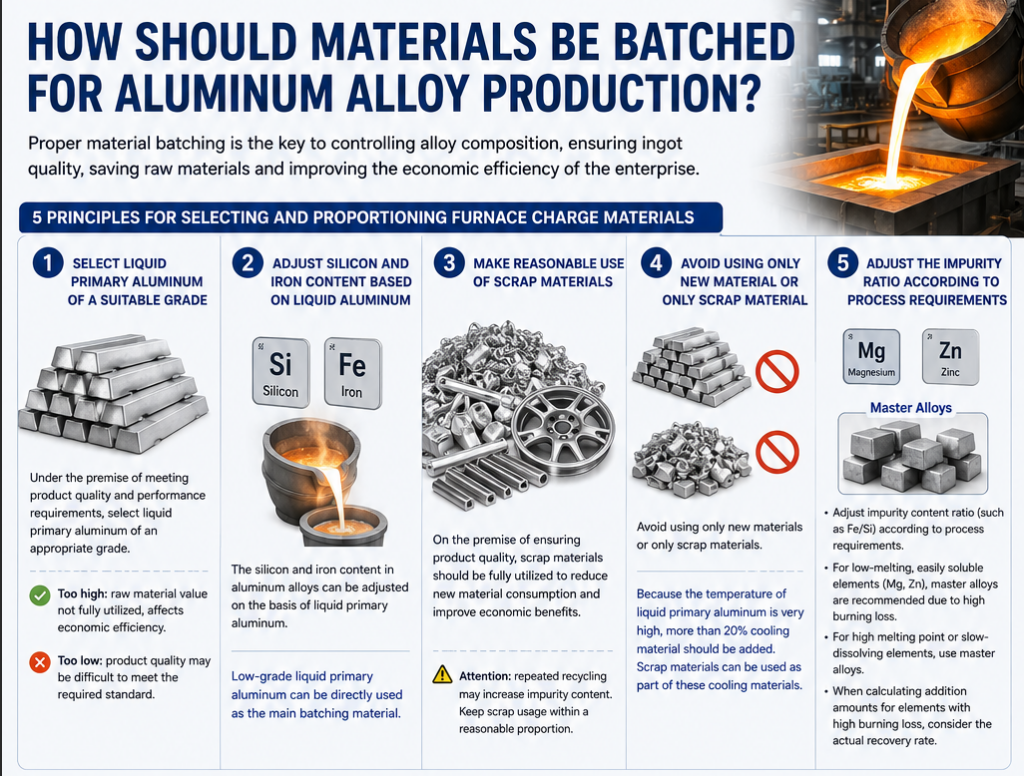
The main principles for selecting and proportioning furnace charge materials are as follows:
1. Select Liquid Primary Aluminum of a Suitable Grade
Under the premise of meeting product quality and performance requirements, liquid primary aluminum of an appropriate grade should be selected.
If the grade is too high, the use value of the raw material is not fully utilized, which affects economic efficiency. If the grade is too low, it may be difficult for the product quality to meet the required standard.
2. Adjust Silicon and Iron Content Based on Liquid Primary Aluminum
The silicon and iron content in aluminum alloys can be adjusted on the basis of liquid primary aluminum. In this case, low-grade liquid primary aluminum can be directly used as the main batching material.
3. Make Reasonable Use of Scrap Materials
On the premise of ensuring product quality, scrap materials should be fully utilized according to product application and process requirements. This can reduce the consumption of new materials and improve economic benefits.
However, attention must be paid to the increase of impurity content caused by repeated recycling of scrap materials. Therefore, the amount of scrap used should be kept within a reasonable proportion.
4. Avoid Using Only New Material or Only Scrap Material
During batching, it is best to avoid using only new materials or only scrap materials. Since the temperature of liquid primary aluminum is very high, more than 20% cooling material should be added. Scrap materials can be used as part of these cooling materials.
5. Adjust the Impurity Ratio According to Process Requirements
Under the premise of ensuring product quality, the impurity content ratio in the furnace charge should be adjusted according to process requirements, such as the ratio of iron to silicon.
For aluminum alloys containing low-melting and easily soluble elements such as magnesium and zinc, pure magnesium or zinc metal can be directly used as furnace charge materials. However, because magnesium and zinc have relatively high burning loss, it is better to use their master alloys.
For aluminum alloys containing elements with high melting points or elements that dissolve slowly in molten aluminum, master alloys of these elements should be used as furnace charge materials.
When calculating the addition amount of alloying elements with high burning loss, their actual recovery rate should be considered.
Calculation of Theoretical Batching Amount
In the batching process, the theoretical batching amount should first be calculated.
The theoretical batching amount refers to the actual ingot output of each melting batch. It is usually determined according to the ingot specification, furnace capacity, maximum load of the casting machine, number of ingots cast at the same time, and maximum stroke or ingot length.
The theoretical batching amount can be calculated as:
Q = m × n × S × L × ρWhere:
Q= theoretical batching amount, kgm= number of casting times in the same melting batchn= number of ingots cast at the same time in each castingS= cross-sectional area of the ingot, m²L= ingot length, mρ= density of the alloy, kg/m³